The Quiet Revival: A Tacit Word of Warning
Why the Quiet Revival risks collapsing faith in Christ into faith in Conservative structures

The Quiet Revival
Across the UK, something unexpected is happening: young people, particularly men, are turning to Christianity in surprising numbers. The Bible Society calls this the “Quiet Revival,” citing a YouGov poll that they funded. Yet the broader picture is more complex. The last census showed that for the first time, fewer than half the population of England and Wales identify as Christian. Compounding this, Catholic and Anglican service attendance remains far below pre-COVID levels. Still, the Quiet Revival challenges the dominant narrative of cultural secularisation.
I won’t delve into why this phenomenon is happening, I'd like to avoid the traps of politics, philosophy, or psychology. Instead, I want to focus on the form it is apparently taking and why it warrants a word of warning.
The Danger Behind the Glamour
According to the Bible Society, the Quiet Revival is largely centred on "Evangelical churches". The Google "AI overview" of Evangelicalism is this:
"An evangelical church is a Protestant Christian tradition that emphasises the authority of the Bible, the necessity of a personal conversion experience ("born again"), and the belief that salvation comes through faith in Jesus Christ's atonement on the cross. These churches also stress the importance of spreading the Christian message through evangelism, or the active sharing of the gospel."
The form it has in mind is very big, very fun, very American. You'll recognise it when I show you some further down the page.
Now, I’ve just finished reading Nancy Pearcey’s Total Truth, the winner of the 2004 Gold Medallion Book Award from the Evangelical Christian Publishers Association, and a hugely influential book on the Evangelical scene. In it Pearcey calls Evangelicals to metaphorical arms, urging a Christian “worldview” that challenges secularism and aims to shape culture, policy, and social structures. She frames secularisation and the split between Science and God as a philosophical inheritance of the enlightenment and all that followed. She views this as an obstacle to the Kingdom of God.
The problem is that Pearcey overlooks how her Evangelicalism is rooted in a conservative, pro-American worldview. Christ is not just another worldview, yet her framework treats Him as one. Ironically, this mirrors the “henotheism” (placing God as just another thing to worship amongst things) she aims to deconstruct, despite her disdain for deconstruction. Her “Biblical worldview” assumes Christianity requires structural influence and social recognition; not the weak, transformative power of Christ on the Cross, but the strong power of the religious cultural dictators He so often challenged and condemned.
This is the risk for young people drawn to Evangelicalism. Too often, it prioritises power over surrender, identity over transcendence, recognition over humility, and belonging over baptism. This is, from an existential and liberal perspective, not the Gospel. To embrace Pearcey's distortion, one must overlook much of the New Testament: the incarnation, the lost years, Christ’s temptation, and His divine emptying in Gethsemane. For a “Biblical worldview,” it is strikingly short on Biblical wisdom and engagement.
Stripped of theologies Catholic and Orthodox roots, Evangelicalism risks becoming individualism dressed as religion, using Christic language to legitimise self and identity. Beyond the worship songs, clothing, celebrity preachers, and sense of belonging lies an institution that fails, not through malice or a lack of sincerity, but because it pushes a worldview. And worldviews are not Christ. Worldviews are politics.
If we take Pearcey as representative of Evangelical Christianity and its "worldview theory", the "Quiet Revival" must be viewed with caution. Here's why.
"The Quiet Revival" - Big Church Festival 2025
When Faith Becomes Ideology
Most religious leaders fall into two camps. On the left are those who believe the Church should bend its theology to accommodate the world. On the right are those who see theology as too abstract and think the Church should focus on changing the world in its image. Ironically, both fail. The left reshapes the Church to fit the world, often reducing both to nothing. The right, discovering that power is not so simple, gets bogged down in theory they struggle to understand and must simplify it into ideology.
Pearcey falls squarely on the right, as does much of Evangelicalism. And that is the problem. Evangelicalism often risks becoming ideological, occasionally developing the insular traits that mark cultic behaviour. Its theology is closed-minded, guarded, and guided by intellectuals (often with their own financial interests in the Chruch) outside mainstream academia, and its literature rarely faces critique from the wider Christian community—any criticism is quickly "othered", dismissed as biased and wrong, and ultimately held up as evidence of the heretical state of Christendom outside of Evangelicalism.
At its worst, then, Evangelicalism entrenches individualism and psychological splitting – "us against them"– the very dangers the New Testament warns against.
But I don't wish to throw the baby out with the bathwater.
As at its best, Evangelicalism pushes worship and a Christian faith to an extraordinary phenomenological level of experience. My own journey has been deeply involved with this. The music of Phil Wickham, Pat Barrett, CAIN and Elevation Worship have helped me articulate what it means to turn to Christ within a contemporary framework. TV series like The Chosen and House of David have articulated what it means to live within the presence of God in ways that Orthodox traditions maybe fail to capture for digital generations raised within contemporary media consumerism.
BUT, and this is a big but – my understanding and appreciation of Evangelical form and content is rooted in Orthodox theology. It is rooted in pluralism and deconstruction. So when Phil Wickham sings:
"You didn't come for religion, you want a relationship with me"
I know this isn't about a Church. This isn't about a Pastor. This isn't about being a Christian at all. This is about an event. The event of God breaking into my life – just as He broke into the world – and transforming it.
Phil Wickham - deeper than Evangelicalism might acknowledge?
Because the point is that Evangelical Christianity, as a form of faith, has nothing to fear from Orthodoxy and academic theology. Postmodernism does not deconstruct Christ. He remains above it. Below it. Beside it.
In fact, the understanding and depth of faith that theology can bring only makes the Evangelical message sing louder, harder, and with more sincerity. I can tell you, that having read the likes of Paul Tillich, H.R. Niebuhr, John Caputo and Dietrich Bonhoeffer (who would all be seen as apostates within Evangelicalism), that the song and clip below only hit with more profundity and truth because of them.
Christianity is not a world view, it is an experienced event for each individual, the claiming of a heart by God, and a lifetime making sense of it.
Evangelicalism has the popular capacity to outline this experience within modern culture, and articulate it brilliantly for those who have experienced it. But, as Marshall McLuhan famously said, "the medium is the message," and Evangelicalism risks blurring the lines between the two. Suddenly—as in the first video—God is not the event; a concert is. In the clip from The Chosen, I don’t need to suffer; Mary does. Christ is no longer an experienced event, but a spectacle embedded in culture. The clips above show how the form of worship, a concert or a TV show, can easily be mistaken for faith in a culture that secularly worships these things.
So my concern isn't with the content of the Evangelical faith. My concern is with it's structure and its apparent closed mindedness and gatekeeping. It's reluctance to engage with the outside world, whilst simultaneously denouncing it and paradoxically imitating it. It's focus on attacking dualism, whilst perpetuating it. And it's capacity to reduce a transcendent faith to mere culture, society and identity. As with so many institutional religions, it can over emphasise the symbolic, and forget the symbolised. In Lacanian terms, the Evangelical Church risks mistaking the signifier—the symbols of faith—for the signified, the living Christ Himself. Yet, He is the most important thing to recognise. Just as Jesus says:
"Many will say to me in that day, ‘Lord, Lord, have we not prophesied in Your name, cast out demons in Your name, and done many wonders in Your name?’ And then I will declare to them, ‘I never knew you; depart from Me, you who practice lawlessness!" (Matthew 7:21-23)
This youthful turning to Evangelical Christianity has not appeared out of the blue. This development is not unexpected, nor should it be dismissed outright, and as I said, let's not throw the baby out with the bathwater. American Evangelicalism provides a religious context rich in community, emotional engagement, and participatory experience that perhaps Orthodoxy struggles to provide. It gives contemporary people a contemporary Christianity. But the potential concern here is that the contemporary issues of intellectual flattening, psychological splitting and political entrenchment cross over into the contemporary faith.
This is exactly what Pearcey does in Total Truth. She flattens centuries of theology, philosophy, and psychology to serve a theocratic vision. The towering intellects of Augustine, Aquinas, Rousseau, Marx, and Freud are forced into corners they never inhabited. She misrepresents and instrumentalises reason to sustain a dualistic narrative—the one true Christianity (American Evangelicalism) under attack from the evil “other.” Her confidence depends on readers never having encountered these thinkers for themselves. Then, in a final irony, she condemns secular culture for being manipulative and dishonest.
Presence, Not Power
But this approach to Christianity is not enough. How can one undertake a literal reading of the Old Testament book of Jeremiah for example, and not come away feeling like Yahweh is a vengeful, cruel and violent God? It isn't until Theology gives you context, metaphor, symbolism and trajectory that you see the psychological, philosophical, existential, historical and redemptive insight that this brilliant book gives. Theology not rooted in Evangelicalism, but the Catholic and Orthodox form of "kenosis". Theology rooted in the humility, self-emptying and weak power of Christ.
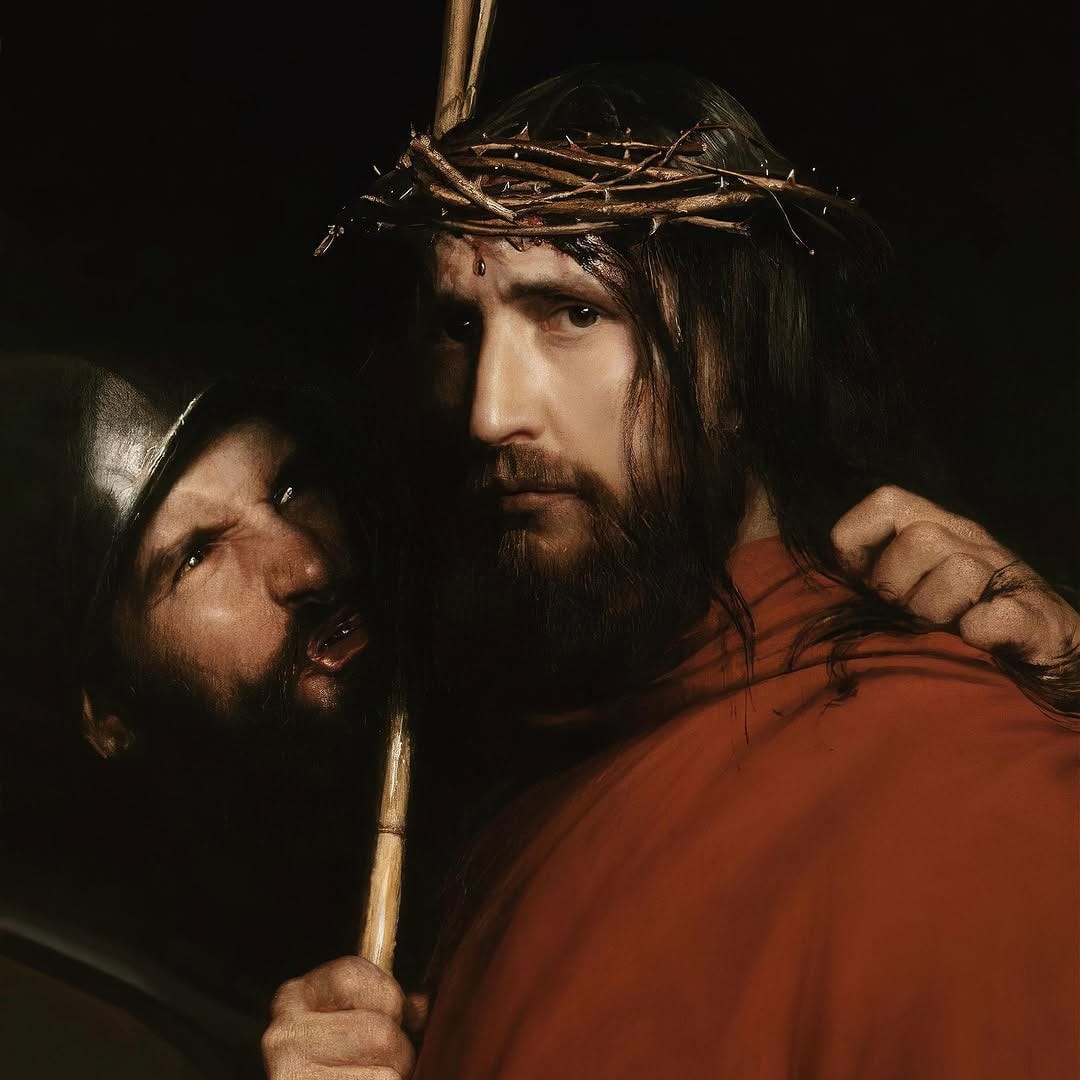
Look at Bloch's painting above. What does it show? Does that look like power? Does that look like influence? Does that look like a strong God?
Or does it look like presence? Does it look like commitment? Does it look like faith?
Does it look like Love?
Bloch’s painting of the Mocking of Christ exposes the scandal of divine weakness. Here, power empties itself into love; transcendence bends low into presence.
This is not domination—it is decreation.
It is not control—it is consent to suffering.
It is not ideology—it is incarnation.
The real issue here, then, is that Evangelicalism does not demand the rigorous theological reflection that gives its own brilliant Christic vision the depth and seriousness it deserves. Instead, it seamlessly integrates contemporary culture (with all of its flaws) within a conservative Christian framework. High-budget films and TV shows, celebrity pastors and worship groups, music festivals, branded clothing, and social media presence all contribute to a mediated spectacle that mirrors broader individualistic trends in Western consumer culture.
This cultural appeal helps explain its attraction to young people, but too often prioritises identity and experience over theological depth and the spiritual challenge offered by Christ and the New Testament. Christ does not call us to an identity rooted in the world—a gaze that sees only through a glass, darkly—but to transcendence in Him.
He does not call us to be Christians.
He calls us to follow.
And there is a difference.
Or the "not so Quiet Revival", perhaps?
What Jesus Offers
This flattening of God and His creation into the ideological binaries and ethical dualism that we see in Pearceys book is exactly what Jesus opposes. Aside from left and right, He offers a third way—not a worldview, but the truth behind all worldviews. As the disciples learn (much to their dismay), the Messiah does not come to challenge secular power, crush Rome, or interpret Yahweh through theology. Instead, Jesus essentially says:
“Don’t worry about all that…just follow me.”
In the Gospels, Jesus does not push a worldview of “Total Truth.”
He is Truth:
“Everyone on the side of truth listens to me” (John 18:37, NIV).
The "Quiet Revival", reading this literally, risks flipping this into an emphasis on action.
But Jesus is not action; He is presence—the presence of a God of Love among His creation, holding His real head in His real hands in wonder at how much we get wrong. He refuses to play politics. He refuses power. Even to the point of death, He displays what theologian John Caputo calls “weak power”—power not of this world, felt but never held. Or, as Huey Lewis might say, the power of Love.
Young people in the UK don’t need another “worldview” to manipulate them or empty their pockets. They don’t need an Evangelical Christianity rooted in the American conservatism that helped strip the meaning from their lives in the first place. What they need – what we all need – is to transcend worldviews altogether.
And here lies the real good news: that this is exactly what Jesus came to do. Even better, it is embedded within the Orthodox theology and Western philosophy that the UK was built upon—the very traditions Pearcey often casts as Evangelicalism's enemies.
This is the message the Quiet Revival needs to hear. It's not that Evangelicalism is inherently wrong in content. A good, grounded faith in this world will have community, festivals, parties, films. It will be joyous and fun. But it's imperative these remain rooted in Jesus and don't just point to Him whilst reinforcing tribalism, identity and political conservatism. In this framework, becoming a "Christian" just becomes another thing for the ego to try and possess. It misses the point.
The problem with our younger generations, is that they are desperately searching for meaning within a cultural framework that has structurally ignored transcendence for the sake of material identity. I know because I'm still just about one of them. What we need to discover is Christ, not as a "worldview" of "total truth", but as the incarnation of the Loving God that holds us all. Not a religion institutionalised within a particular Church, holding up Brandon Lake songs, Steven Furtick sermons, flashy festivals and hoodies with crosses on masquerading as faith. What the structure of Evangelicalism, and therefore the "Quiet Revival" risks, is mistaking the moon for the finger pointing at it.
A turn to God is not about Christianity.
It is not about holding a worldview.
It is about Christ Himself—the presence of God above and among us.
It is about surrendering the illusions of power and structure, pride and identity, autonomy and self-sufficiency; and letting Christ Himself transform our lives, uniting what the world divides.
As Nightcrawler tells Wolverine whilst handing him a Bible in the X-Men:
"See the world with different eyes."
As churches supposedly swell with music, spectacle, and bravado, one must ask: is this the faith our UK culture truly needs, or merely a borrowed show of Americanised Evangelicalism? And more importantly, in a society concerned with patriotic renewal and cultural erosion, what does Britain’s own Christian legacy have to offer?
The answer is… a hell of a lot, actually.
POST SCRIPT - 16/11/2025
It's been pointed out to me that perhaps this piece may come across to some as a bit harsh on American Evangelicalism. This was not my intention, and as I hope I showed, I'm actually very appreciative of it's forms and structures – I am simply concerned that they remain focussed on Christ.
I'd also like to highlight that this piece was written with a secondary objective in mind: An underhanded critique of the ideological co-option of Christianity by the British far right (through the lens of its ideological co-option by American conservatives). I wont get into this here. I'll let Tommy Robinson speak for himself in the interview below, where he discusses the "weak and pathetic" Church, and a need for a "masculine, strong Christianity" that would probably be separate from the Church. He also highlights his admiration for "American pastors". Perhaps the kind of Pastors discussed above?
Hopefully, armed with what I've discussed above, you'll be able to recognise the ideological and theological category errors he is making through projecting his own political beliefs and self-image onto Christ – and the danger this poses to the very Western culture that Tommy Robinson claims to defend. As I explained to my children just last week, Christ isn't dangerous because He wields worldly power – He is dangerous because He exposes it, disarms it, undermines it, shames it and ultimately, embarrasses it.
To highlight my overall point further, I've also added two songs from American Evangelical artists, that give a perfect Christic response to Tommy Robinson. The Phil Wickham song in particular is inspired. The bridge from 2:30 puts into song the essence of Christianity: You have a choice. Make it wisely.